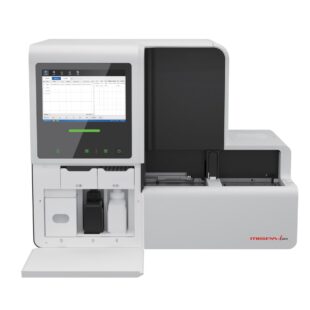
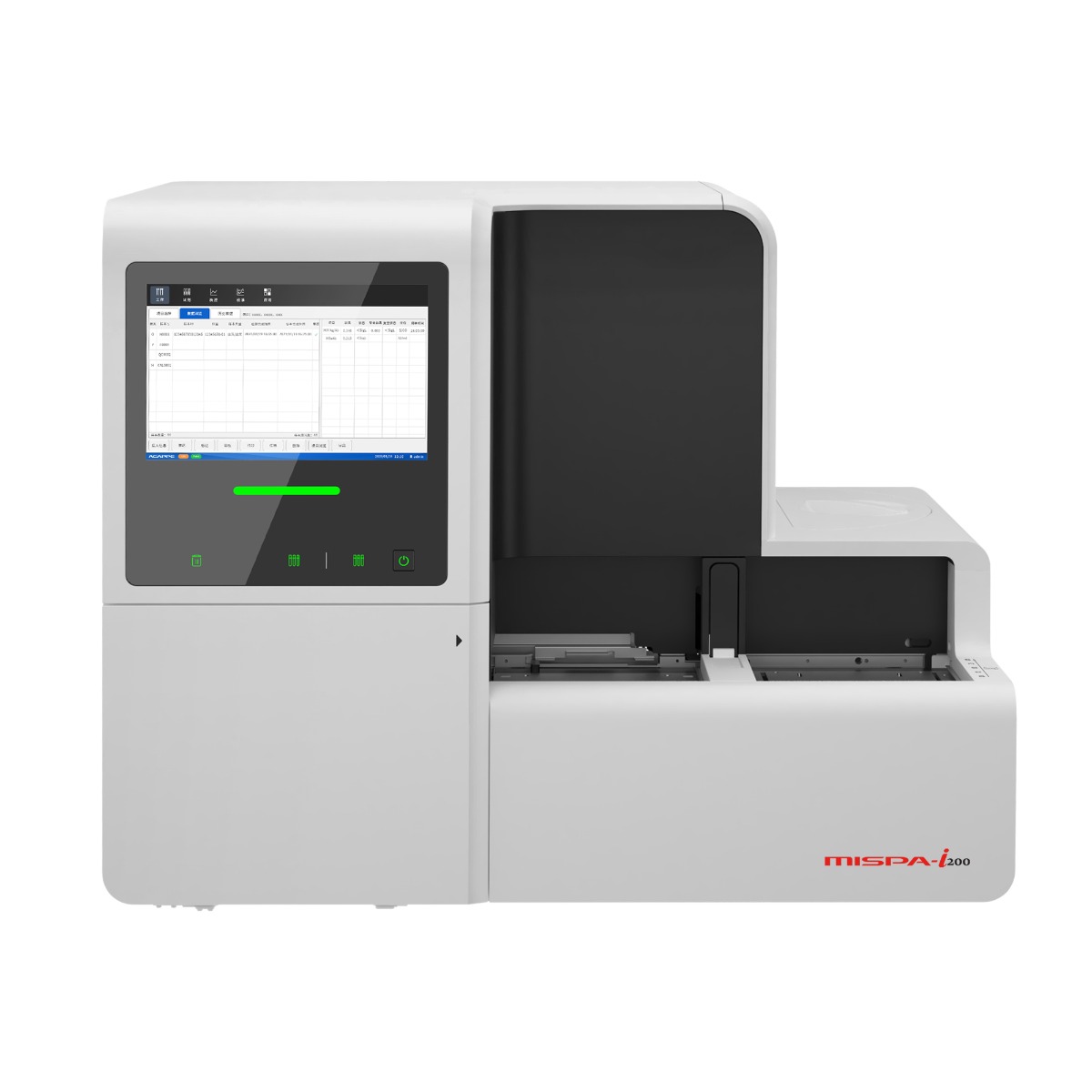
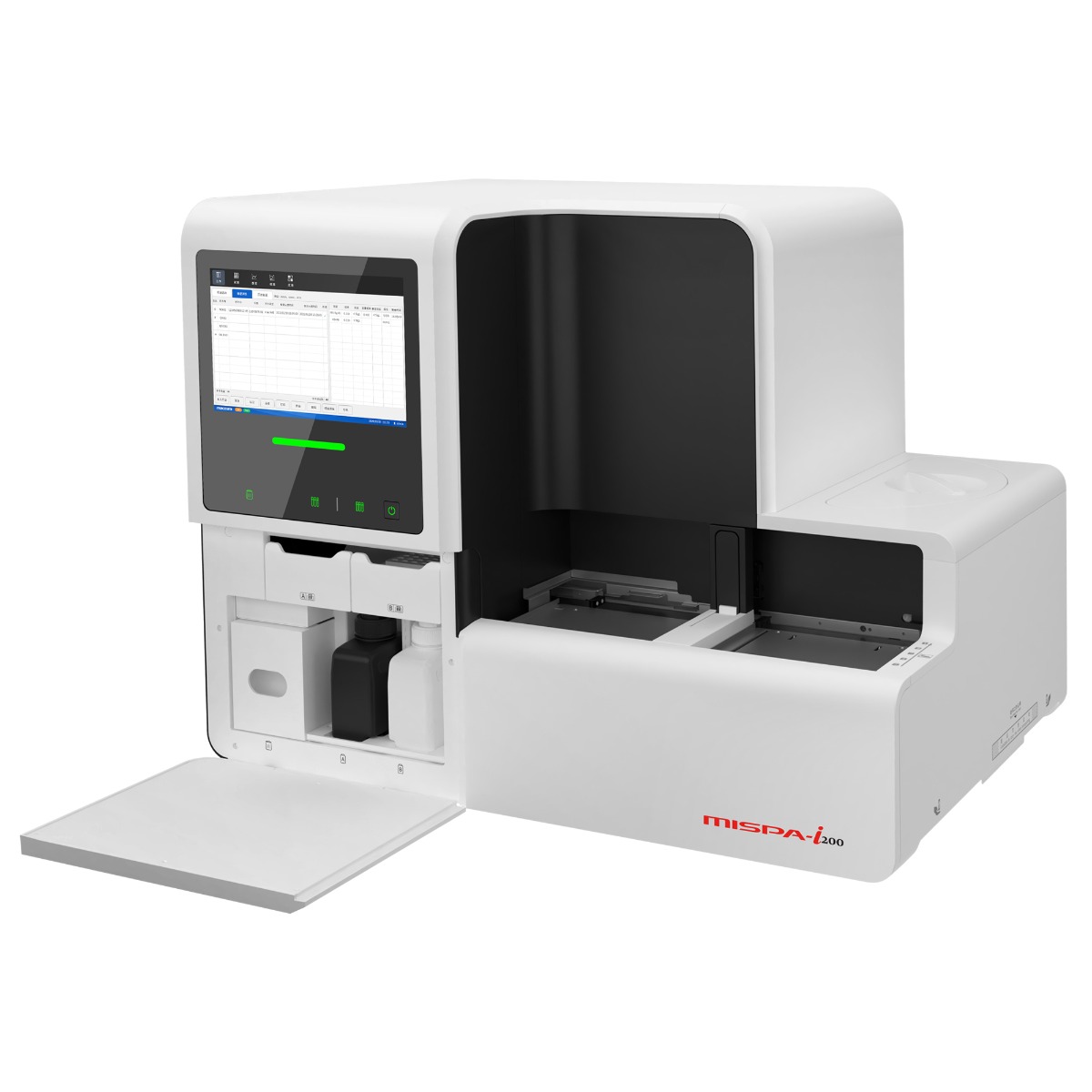
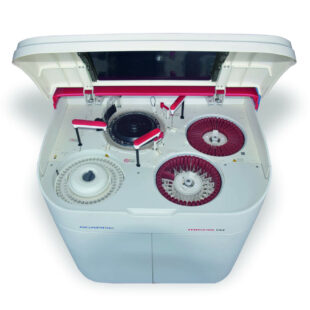
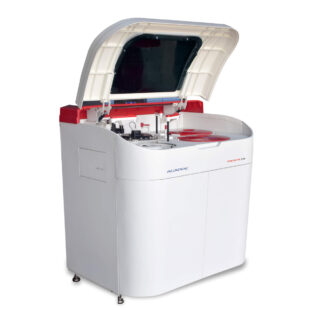
The Mispa i200 Automatic Chemiluminescence Analyzer satisfies the detection needs of diverse application situations by employing direct chemiluminescence technology based on Acridinium Ester and magnetic particles. With comparable positioning models, it has a significant advantage and the fastest analysis speed of 200 T/H.
Features:
Throughput of 200T/Hr.
Random Access Compact CLIA
20 reagents positions with Auto RFID Management and Online Reagents Loading
50 Sample Positions with Automatic Barcode Scanning and Identification
Capable of loading 208 cuvettes continuously at once; Individual cuvette is used for each test.
Patented magnetic separation technology, complete washing is guaranteed without any magnetic bead loss.
Wash buffer and substrate can be placed inside the instrument without any temperature control.
Advanced Photo Multiplier Tube (PMT) module with an extensive sensing area and fast response time.
Reagents are Labelled with a chemical compound called Acridinium Ester which is 100 times stronger chemiluminescence intensity compared with other enzyme labels.
Separate compartment to collect the used cuvettes by separating the solid and liquid wastes which efficiently reduce the biohazardous risks.
Alarm indication to the operator during equipment malfunctions, process deviations and reagents expirations.
Inbuilt PC with touch screen interface for easy operations
First Indian IVD manufacturer to Commission in house CLIA Reagents Production line.
Throughput of 200T/Hr.
Random Access Compact CLIA
20 reagents positions with Auto RFID Management and Online Reagents Loading
50 Sample Positions with Automatic Barcode Scanning and Identification
Capable of loading 208 cuvettes continuously at once; Individual cuvette is used for each test.
Patented magnetic separation technology, complete washing is guaranteed without any magnetic bead loss.
Wash buffer and substrate can be placed inside the instrument without any temperature control.
Advanced Photo Multiplier Tube (PMT) module with an extensive sensing area and fast response time.
Reagents are Labelled with a chemical compound called Acridinium Ester which is 100 times stronger chemiluminescence intensity compared with other enzyme labels.
Separate compartment to collect the used cuvettes by separating the solid and liquid wastes which efficiently reduce the biohazardous risks.
Alarm indication to the operator during equipment malfunctions, process deviations and reagents expirations.
Inbuilt PC with touch screen interface for easy operations
First Indian IVD manufacturer to Commission in house CLIA Reagents Production line.
Automatic Realtime mixing of Magnetic Beads
Temperature Control of Reagents: 2- 8c
Dedicated STAT Position to prioritize the emergency Sample.
Sample first protocol (No reagent Loss due to sample shortage or clot)
Needle has the detection function to the liquid level, clot, Collison, and aspiration failure.
Time to the first result: 14 minutes.
Multiple magnetic separation system minimized magnetic beads loss and ensure perfect performance.
Continuous reagents replacement and samples loading during the operation.
Compatible with HIS/LIS
Carry-over is less than 0.1ppm
Graphical representation of QC analysis
Lot Specific System Pack Reagents with calibrators.
Technology:
Immunoassays are a group of biochemical tests used to measure the concentration of specific molecules, such as proteins, hormones, drugs, or infectious agents (e.g., viruses or bacteria) in a biological sample. Immunoassays rely on the specificity and sensitivity of the antigen-antibody binding reaction.
Chemiluminescence immunoassay (CLIA)
Chemiluminescence (CL) is defined as the emission of electromagnetic radiation caused by a chemical reaction to produce light. Chemiluminescence immunoassay (CLIA) is an assay that combine chemiluminescence technique with immunochemical reactions.
Chemiluminescence is a chemical reaction that emits light when specific molecules interact. It is highly sensitive and precise, compared to other immunoassays.
CLIA utilize chemical probes which could generate light emission through chemical reaction to label the antibody. CLIA has gained increasing attention in different fields, including life science, clinical diagnosis, environmental monitoring, food safety and pharmaceutical analysis because of its high sensitivity, good specificity, wide range of applications, simple equipment, and wide linear range.
CLIA with Chemical Label
This kind of chemical with special structure can transfer to an excited state through chemical reaction. Photons would be released when the chemical fell to ground state from the excited state. The typical chemical is acridinium ester and its derivatives. Acridinium labelled compounds have 100 times stronger chemiluminescence intensity compared to luminol labelled ones, and acridinium esters have the dominant feature that they do not lose the luminescence efficiency even after binding to antigen or antibody. And the chemistry is simple that no enzyme needs to be involved.






Reviews
There are no reviews yet.